Inside the Room: The 24th Music Business Network
Noxolo Mshweshwe · 16 July 2026 · 7 min read
By Lloyd Chikamba | SkillGuide
SUBFRQNCY Management & Brandlift Digital
Email: lloyd@brandliftdigital.co.za
People were sitting on the stairs by the time the programme started at Artistry. Every seat was gone, with the overflow finding floor space wherever it could.
That detail matters more than any guest list because it tells you who actually shows up for this kind of event in South Africa versus who claims they would if invited. The crowd split roughly evenly between artists and the people who run the business side - managers, administrators, label heads, and industry professionals. Most industry events here skew heavily one way or the other. This one didn't, and that balance is worth noting because it's the balance the industry itself is short of.
Tsenolo Africa carried the room for most of the night. She's Sony Music Publishing's A&R Manager in her day job, and it showed in how she worked the floor.; jokes landed, conversations flowed, and the thread was never dropped. The difference between a panel that informs and one that simply fills time usually comes down to whoever is holding the microphone between speakers. She held it.
The SAMA process, and the tracking problem nobody wants to sit through
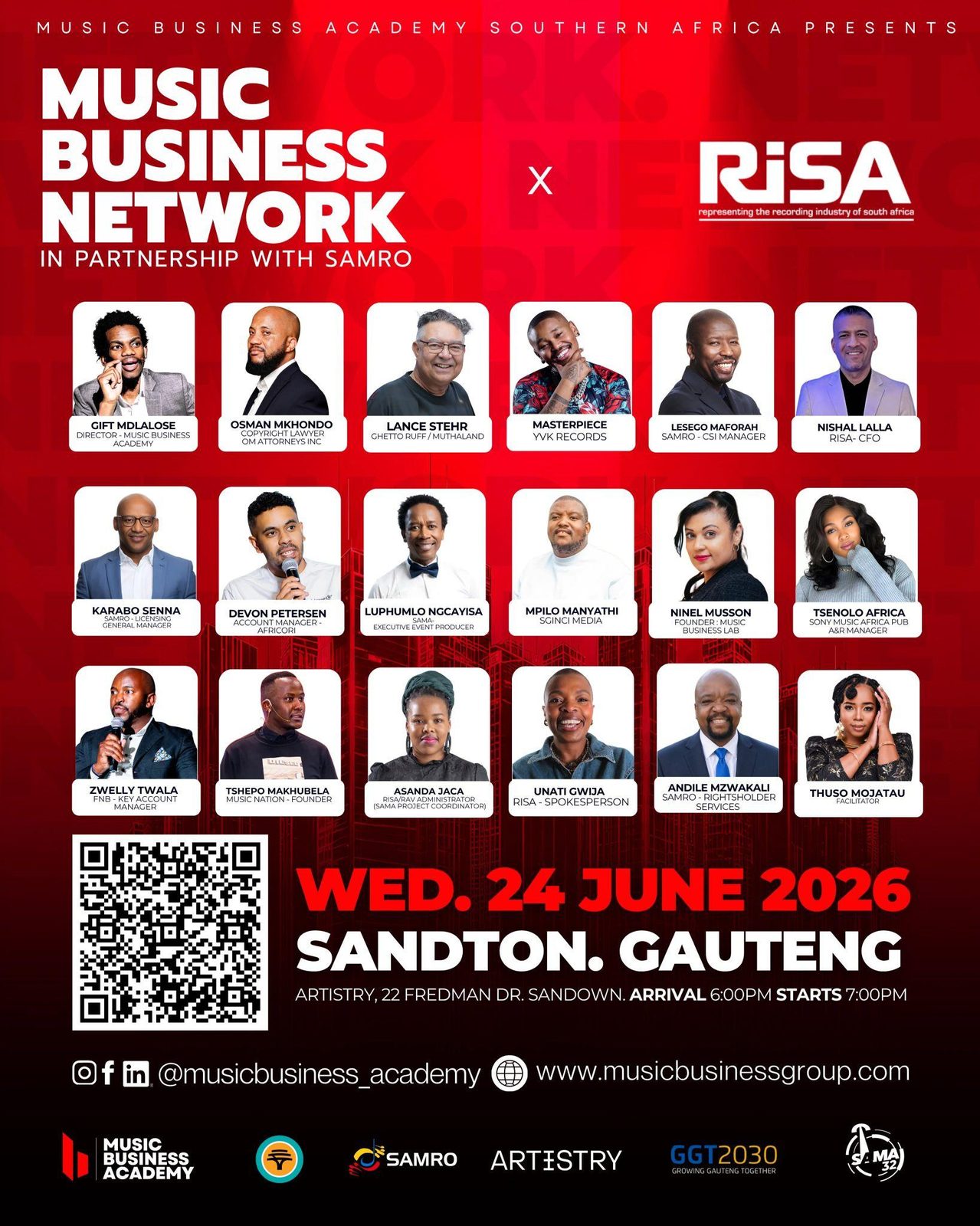
Luphumlo Ngcayisa opened with the SAMA submission process—the kind of walkthrough artists usually only receive after they've already missed a submission window or completed a form incorrectly. He was joined by RISA's Nishal Lalla, Asanda Jaca, and Unati Gwija.
Gwija's segment on grassroots PR landed harder than it should have needed to. Most managers only start caring about profile-building after there's already a profile worth protecting. By then it's reactive, not strategic.
Lalla's piece on ISRC codes was the most consequential thing said all night, and almost nobody in the room will remember it that way. Register your work properly. Get your codes assigned correctly because that's the mechanism RISA uses to track usage. Royalties are paid on plays tracked through RISA and SAMRO. No code means no attribution and no payment. It doesn't get flagged as missing money—it simply never arrives, and most artists never work out why.
In an environment where AI-generated and AI-assisted content is multiplying faster than rights infrastructure can adapt, correct metadata is the difference between getting paid for your own work and having no way to prove it was yours in the first place. This isn't a future problem. It's already here.
The part of the ecosystem that isn't the stage
Ninel Musson and SAMRO's Lesego Maforah covered ground that reframed how I think about where value is actually created in this industry. Maforah walked through SAMRO's new CSI programmes, funding now available to members, and an upcoming learning portal featuring video content aimed at new artists and those entering the industry for the first time.
Musson spoke about Music Business Lab, which has moved beyond informal upskilling into university-accredited courses—a genuine credentialing shift for a sector that has historically run on reputation and word of mouth rather than formal qualifications.
A handful of MBL cohort members were in the room. Some were from Zambia. Others were building technology specifically for the music business rather than making music themselves.
That's the real insight from this segment—not the funding numbers. You don't need to be the artist to have a stake in this ecosystem, and most young people circling the industry haven't yet realised that infrastructure roles, licensing specialists, rights administrators, and technology builders are viable careers in their own right, not consolation prizes for people who couldn't make it as performers.
Karabo Senna and Andile Mzwakali walked through SAMRO's publishing and licensing functions, facilitated by Thuso Mojatau—an artist and businesswoman carrying as much weight in that room as anyone on the formal panel.
Publishing and licensing is the part of the business that puts a lecture hall to sleep but completely restructures someone's income the day they finally understand it. There's no way around that boredom. It's simply the price of the knowledge.
Lance Stehr, and the one answer everyone actually came to hear
The main segment belonged to Lance Stehr, co-facilitated by Gift Mdlalose (whose own book on the music business is available here) and Tshepo Makhubela.
Stehr started in this industry in the 1980s, built Ghetto Ruff out of the Prophets of Da City lineage, and has watched the business model reinvent itself at least three times since. He confirmed that the Spinners Season 2 soundtrack is landing later this year and spoke about pursuing projects with cultural relevance over those that are purely commercial—a stance that carries far more weight coming from someone with his catalogue than it would from almost anyone else.
His comments on AI were the sharpest of the evening precisely because they refused to be dramatic in either direction. Potential issue. Also a tool. No panic. No evangelism. That kind of calibration is rare from someone that far into a career. Most people at that stage have either dug into fear or bought fully into the hype. He had done neither.
Osman Mkhondo covered the legal landscape and, I'll be honest, I didn't extract as much from that segment as the man's résumé deserved. With more than two decades as a talent attorney, he's done work that most artists in that room will never know happened on their behalf until it already has. That's a gap in my note-taking, not in what he had to offer.
He repeatedly stressed that emerging artists are failing to clear samples, and it's costing many of them both now and later. Case in point: he produced arguably South Africa's biggest song, Sister Bettina, almost 20 years ago. As massive as the record still is, the sample was never cleared, meaning it could never fully generate the royalties it otherwise would have.
Devon Petersen, who manages Sam Deep and works as an Account Manager at Africori, spoke about intentionality and gave a clear-eyed assessment of where Africori sits in South Africa's distribution landscape. He credited former head Yoel by name, which seems like a small detail but says something much larger. Africori's current position in the market didn't happen by accident. Specific people made specific decisions, and Petersen knows exactly which ones mattered.
Mpilo Manyathi drove up from KwaZulu-Natal for the event. He's a significant presence in the maskandi space, managing talent that doesn't always receive airtime at forums like this.
Someone asked how he deals with people thinking he's foolish for constantly pushing merchandise, even during periods when the T-shirts weren't selling. His response: "Actually, if you're not selling all the time, you're the bhari."
The room erupted in laughter.
He's also right, and it's worth sitting with beyond the joke. The people mocking constant hustle from the sidelines are usually the ones with nothing of their own to sell.
Masterpiece YVK delivered the most honest observation of the night. He gave credit to the organisers for creating the forum while acknowledging that it still isn't reaching grassroots artists. Most of the people who would benefit most from a room like this don't know it exists. That's not a criticism of the event. It's simply the next challenge the Music Business Network has to solve if it wants to move beyond serving people who are already plugged into the industry's existing networks.
The judgment nobody said out loud, and what I'm taking with me
The Constitutional Court's judgment on the Copyright Amendment Bill landed two days after this event. It came up briefly on stage, mostly as context for what the Bill covers and how it affects every player in the market, but it wasn't treated as the headline of the night.
The timing nevertheless hung over the room, regardless of how much airtime it received. Everyone there now operates within whatever framework that ruling reshaped, whether it received a dedicated session or not.
DJ La Vita was in attendance, and it was good to see her name on the guest list rather than simply hear about her second-hand. An Africori alumna and Pretoria native, her body of work in the Deep House and Afro Tech space is a testament to her skill. Her work is worth following at @lavita_dj.
I also made a few contacts worth keeping, Lindi The Artist among them—a fellow artist manager and a creative in her own right, someone I'll stay in touch with long after this one evening.
What I'm carrying forward is this: 1. AI isn't a future consideration. It's already reshaping attribution and royalty flows in real time, and any manager treating it as somebody else's problem is going to be blindsided by it.
2. Managers aren't a separate function sitting outside the artist-industry relationship. We're supposed to move in lockstep with both—not just booking gigs and chasing brand activations while the rights and revenue infrastructure evolves without us.
3. And licensing—sampling in particular—is the area where the most confident people in the room are often the ones who've never actually had to defend a claim.