Half Full Directory Launches to Connect South Africa’s Creative and Communications Talent to Opportunity
Noxolo Mshweshwe · 33 min read
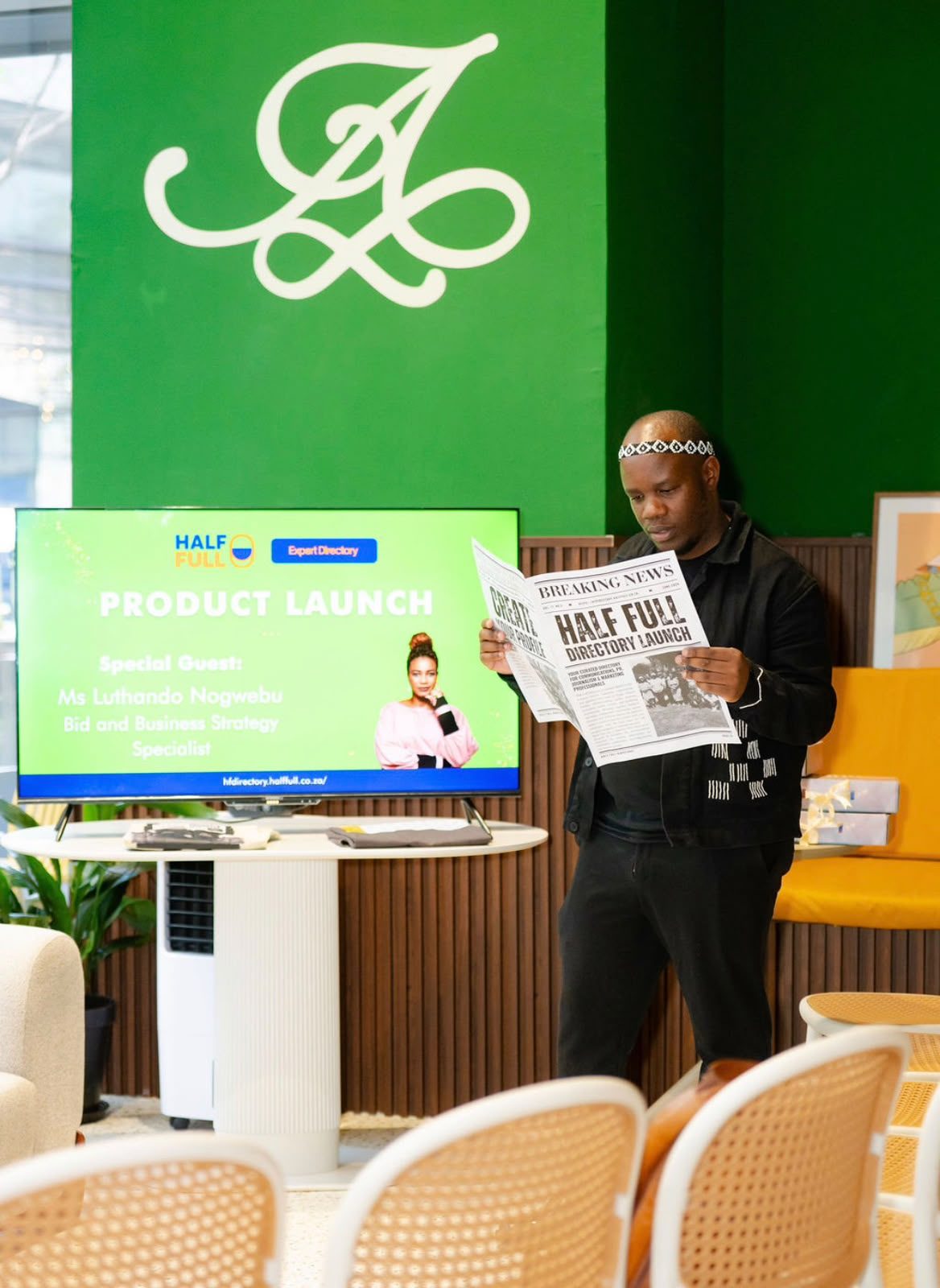
16 June 2026 marked the launch of the Half Full Directory — a new platform designed to make it easier for brands, businesses and organisations to find professionals across South Africa’s communications, public relations, journalism and marketing industries.
And honestly, we need more of this.
Because South Africa does not have a shortage of talent.
We have a visibility problem.
We have young graduates with qualifications but limited professional networks. Freelancers who can do the work but struggle to get in front of the people who need their skills. Entrepreneurs building businesses from the ground up. Creatives who are exceptionally good at what they do but are still waiting for someone to discover them.
At the same time, businesses are looking for the right people — and often don't know where to find them.
That is the gap that directories like Half Full can help close.
Opportunity does not always look like a job advert
When we talk about unemployment, particularly youth unemployment, the conversation often centres around jobs.
And rightly so.
But opportunity is bigger than employment.
It can be a freelance brief.
A consulting opportunity.
A collaboration.
An internship.
A referral.
A first client.
A mentor.
A business partnership.
Sometimes it is simply meeting the person who knows the person who is looking for exactly what you do.
South Africa's youth unemployment rate stood at 45.8% among people aged 15–34 in the first quarter of 2026.
That number is not just an economic statistic.
It represents millions of young people trying to figure out where they fit into an economy that is not creating opportunities quickly enough.
Which means we need to think differently about how opportunities are created, communicated and accessed.
Be good. But also be findable.
One of the biggest lessons I keep coming back to when talking about employability and entrepreneurship is this:
Being good at what you do is only part of the equation.
People need to know that you exist.
They need to understand what you do.
They need to know how to contact you.
And, importantly, they need enough confidence in your professional presence to consider working with you.
That is where platforms such as the Half Full Directory become interesting.
The directory brings together professionals across communications, PR, journalism and marketing, allowing users to search by discipline, specialism, location and services. It also says that listed experts are reviewed and approved before being included, while profiles can provide direct contact routes.
That sounds simple.
But simple infrastructure can solve very real problems.
Your network is part of your professional capital
There is a saying that your network is your net worth.
I don't think it should be taken literally.
But I do think there is an important truth underneath it:
Relationships create access.
The person you meet at an industry event could become your next client.
The person you connect with on LinkedIn could recommend you for a role.
The freelancer you meet today could become your business partner tomorrow.
The entrepreneur sitting next to you could introduce you to an investor six months from now.
The journalist you build a genuine relationship with could eventually cover your business.
Networking is therefore not about collecting business cards or adding hundreds of people on LinkedIn.
It is about building relationships before you urgently need them.
And that is particularly important for young people entering industries where experience, reputation and relationships can have an enormous influence on who gets the opportunity.
Directories make professional ecosystems easier to navigate
A directory is not going to solve unemployment.
Let's be clear about that.
But it can remove one of the barriers between talent and opportunity: discovery.
For a small business owner looking for a social media manager, finding the right person should not require asking five people for recommendations.
For an organisation looking for a PR practitioner, journalist or communications specialist, there should be places where that talent is easier to find.
For a young professional trying to build a name, there should be opportunities to put their skills in front of people who may actually need them.
This is particularly valuable for freelancers, consultants, entrepreneurs and emerging professionals who may not have the institutional networks that come with working for a large organisation.
The Half Full Directory is currently built around communications, PR, journalism and marketing — four industries where relationships, visibility and reputation are particularly important. The platform already brings together hundreds of registered experts across a range of specialisms.
Young people need more than motivation
This is something I feel strongly about.
We cannot keep telling young people to "network more", "build their personal brand", "start a business" and "put themselves out there" without also building the infrastructure that makes those things easier to do.
People need access.
They need information.
They need platforms.
They need communities.
They need introductions.
They need places where their skills can actually be seen.
And yes — they need to learn how to present themselves professionally once the opportunity arrives.
Because the goal isn't simply to get young people into rooms.
It is to make sure they are ready when the right door opens.
Entrepreneurship needs ecosystems too
The same principle applies to entrepreneurs.
Starting a business can be incredibly isolating, particularly when you are building with limited resources.
Your first customer may come through a recommendation.
Your first supplier may come through someone in your network.
Your next collaborator may be someone you met at an event.
Your breakthrough opportunity may come from someone who simply remembers your name.
That is why ecosystems matter.
We need more spaces where entrepreneurs, creatives, professionals, businesses and organisations can find one another.
We need more opportunities for people to say:
"This is what I do."
And for someone else to respond:
"Actually, I need exactly that."
That is the magic of connection.
From being unemployed to being discoverable
There is also a mindset shift worth having here.
If you are a young professional looking for work, don't only think about where you can submit your CV.
Think about where you can be found.
If you are a freelancer, don't only wait for someone to post a brief.
Make it easier for people to discover your work.
If you are an entrepreneur, don't only focus on selling.
Build relationships.
If you are a student, don't wait until graduation before you start meeting people in your industry.
Start now.
And if you are an established professional, remember that your network can become someone else's opportunity.
Open a door. Make an introduction. Share a contact. Recommend someone.
Sometimes that is the difference between someone being overlooked and someone getting their first opportunity.
The launch of Half Full Directory is a small but important step
The Half Full Directory officially launched on 16 June 2026, creating a dedicated space where businesses can discover professionals and where professionals can make themselves more visible to the market.
And perhaps that is the bigger lesson here.
We don't only need more jobs.
We need more pathways to opportunity.
We need stronger professional networks.
We need better visibility for emerging talent.
We need entrepreneurs to know where to find one another.
We need businesses to know where to find skills.
And we need young South Africans to understand that their professional network is something they can start building before they need it.
Because sometimes opportunity isn't missing.
Sometimes it is simply sitting on the other side of a connection you haven't made yet.
The Half Full Directory is one more place to start making those connections.
Explore the Half Full Directory
Find the people. Find the skills. Find the opportunity.
4.
Kotex say It Out Loud: More Than A Campaign
By Noxolo Mshweshwe | Founder, SkillMzansi
Some campaigns launch products.
Others launch conversations.
On Friday, I had the pleasure of attending the launch of Kotex South Africa's #SayItOut campaign at Rosebank Mall, and it was a wonderful reminder of what can happen when purpose, creativity and entertainment come together to create an experience that people genuinely connect with.
From the moment guests arrived, the atmosphere was warm, vibrant and inviting. Over drinks and beautifully presented finger foods, guests had an opportunity to mingle, connect and take in the experience before the official programme got underway.
At the centre of the activation was a striking red telephone installation carrying the words "Say It Out."
The concept was simple but effective: guests were invited to pick up the phone and speak, creating a physical representation of the campaign's call to break the silence around menstruation.
And people did.
There was laughter, curiosity, plenty of content creation and, importantly, conversation.
For me, that was one of the strongest aspects of the campaign. Menstruation is a completely normal part of life, yet conversations around periods can still be accompanied by embarrassment, discomfort and stigma. Creating spaces where people can speak openly is an important part of changing that narrative.
But Kotex didn't stop at conversation.
The campaign also connects consumer participation with tangible social impact. For every participating Kotex product purchased during the campaign, the brand will donate a sanitary pad to a school in need, with consumers able to help determine where those donations go.
That is where awareness becomes action.
As the Founder of SkillMzansi, a platform focused on helping young South Africans build practical skills and access opportunity, I am particularly drawn to initiatives that recognise the connection between access, dignity and participation.
A young person cannot fully engage with school or opportunities when something as fundamental as menstrual hygiene is standing in their way.
Removing those barriers matters.
The launch itself was just as energetic as its message.
A fabulous dance crew brought an infectious energy to the afternoon with a series of high-energy performances that had guests engaged and entertained. Their choreography added another dimension to the activation and helped turn the campaign from something we were simply observing into an experience we were participating in.
[INSERT DANCE CREW NAME] were fantastic, and their performances were one of the highlights of the afternoon.
And then came the finale.
As Kotex's campaign partner, DBN Gogo closed out the event with an absolute killer set.
The energy shifted almost immediately. What had been an afternoon of conversation, storytelling and engagement became a full-on celebration, with guests dancing and enjoying the final moments of the launch.
It was the perfect ending.
There was something fitting about closing a campaign centred on confidence and self-expression with music that had everyone letting loose and enjoying themselves.
Guests also left with thoughtfully curated Kotex goodie bags, extending the experience beyond the event itself. It was a lovely final touch to an afternoon where the brand had clearly considered not only the message it wanted to communicate, but how it wanted people to experience that message.
A Founder's Reflection
As founders, marketers and communicators, we can become very focused on metrics.
Reach.
Impressions.
Engagement.
Conversions.
All of these things matter.
But I think there is another question worth asking:
Will people remember how your campaign made them feel?
That, for me, is where Kotex's #SayItOut campaign gets it right.
It created a conversation without making the subject feel clinical.
It delivered a social impact commitment without allowing the cause to become an afterthought.
It brought entertainment and culture into the experience without losing sight of the message.
And it gave people something to take away—both literally and figuratively.
The most effective campaigns don't necessarily end when the event does.
They continue in the conversations people have afterwards.
They show up in the stories people tell.
And, hopefully, they contribute to changing the way people think about the issue at the centre of the campaign.
For something as ordinary—and yet still so unnecessarily taboo—as menstruation, perhaps the most powerful thing we can do is exactly what Kotex invited us to do:
Say it out Loud
5.
Government Launches the Peo Pele Youth Fund to Support Young Entrepreneurs
Noxolo Mshweshwe Founder | SkillMzansi Young South Africans looking to start or grow a business have a new opportunity to access funding and business support following the launch of the Peo Pele Youth Fund by the Department of Small Business Development (DSBD).
Launched during the Department's Youth Day Commemoration in QwaQwa, Free State, the fund forms part of the government's ongoing efforts to expand economic opportunities for young people by improving access to finance, business development support, mentorship, and markets.
The initiative recognises that while many young people have entrepreneurial potential, they often face barriers such as limited access to funding, business skills, and opportunities to grow sustainable enterprises.
Who is Offering the Opportunity?
The Peo Pele Youth Fund is an initiative of the Department of Small Business Development (DSBD) and is administered by the Small Enterprise Development and Finance Agency (SEDFA).
The fund builds on previous youth entrepreneurship programmes and has been designed to provide more comprehensive support to young entrepreneurs by combining affordable finance with practical business development services.
The launch coincided with the Department's Youth Day Commemoration, marking 50 years since the 1976 Youth Uprising. While honouring the sacrifices of previous generations, the event also focused on the next frontier of freedom—economic participation, entrepreneurship, and business ownership for South Africa's youth.
What is the Peo Pele Youth Fund?
The Peo Pele Youth Fund is a revitalised youth entrepreneurship support programme aimed at helping young entrepreneurs establish, sustain, and grow their businesses.
Rather than offering funding alone, the programme provides a package of support that includes:
Access to affordable business finance
Business development support
Mentorship and technical assistance
Market access opportunities
Entrepreneur support throughout different stages of business growth
According to the Department, the fund is intended to support entrepreneurs from the idea stage through to businesses that are ready to expand and create employment.
Funding will be offered at Prime less 2%, making it more accessible for qualifying youth-owned businesses.
Who Can Apply?
The Department has indicated that the Peo Pele Youth Fund is intended for young South African entrepreneurs seeking to start, sustain, or grow their businesses.
While full eligibility requirements are expected to be published separately, the programme is designed to support youth-owned enterprises across different stages of development.
SkillMzansi will update this article as soon as the official application criteria and qualifying requirements are released.
Opportunity Details
The launch formed part of a broader Youth Month programme hosted across the Thabo Mofutsanyana District Municipality in the Free State.
Activities included:
A Youth Enterprise Readiness Campaign featuring practical entrepreneurship training.
Skills development workshops covering areas such as artificial intelligence (AI), robotics, baking and confectionery, nail technology, and wig making.
An Informal Micro Enterprise Development Programme (IMEDP) equipment handover.
A Youth Enterprise Walk promoting economic empowerment.
A Youth Imbizo led by the Minister of Small Business Development.
A Market Village showcasing youth-owned businesses and entrepreneurship support programmes.
Mobile government and financial services providing access to entrepreneurship support.
The government expects the Peo Pele Youth Fund to contribute to sustainable youth-owned businesses while supporting the creation and preservation of approximately 1,500 jobs.
How to Apply
At the time of publication, the Department of Small Business Development has officially launched the Peo Pele Youth Fund, but detailed application guidelines have not yet been published.
Prospective applicants are encouraged to monitor official announcements from the Department of Small Business Development and the Small Enterprise Development and Finance Agency (SEDFA) for information on:
Opening dates
Eligibility requirements
Required supporting documents
Application procedures
Funding windows
SkillMzansi will also update this article once official application details become available.
Before You Apply
If you are considering applying once applications open, now is a good time to prepare by:
Developing or refining your business idea.
Preparing a basic business plan.
Organising any business registration documents, where applicable.
Gathering financial records if your business is already operating.
Thinking about how funding would help your business grow and create opportunities.
Being prepared before applications open can make the process much smoother.
A Note from the Founder
At SkillMzansi, we believe entrepreneurship is one of the most powerful ways to create opportunities—not only for yourself, but for your community as well.
Access to funding is important, but successful businesses are built on knowledge, preparation, and persistence. Whether you're launching your first business or growing an existing one, take the time to strengthen your skills, understand your market, and build a solid foundation.
We'll continue sharing opportunities like the Peo Pele Youth Fund as more information becomes available, so be sure to check back regularly for updates.
6.
Hospitality Qualification? Here's Your Next Opportunity
One of the hardest parts about finding a job isn't always getting the qualification—it's getting the opportunity to show what you can do.
That's why we're always on the lookout for opportunities that help bridge the gap between studying and starting a career.
Today, we're excited to share an opportunity from Phosaane Training Institute for hospitality graduates who are ready to take that next step.
If you've completed a hospitality qualification and you're looking to strengthen your workplace readiness, this could be an opportunity worth exploring.
Who is Offering the Opportunity?
Phosaane Training Institute is offering a FREE 5-Day Work Readiness Programme designed to help qualified hospitality graduates prepare for the workplace and position themselves for potential work placement opportunities.
The training itself is completely free. However, there is no stipend, and participants will need to arrange and pay for their own transport.
Who Can Apply?
You can apply if you hold a recognised qualification in one of the following:
Food & Beverage Services
Waiter / Waitress
Chef / Professional Cookery
Any other recognised Hospitality qualification
If this sounds like you, we'd encourage you to put your hand up and apply.
Opportunity Details
Duration: 5 Days
Training Venue: Willowbrook Office Park, Corner Hendrik Potgieter Road and Van Der Kloof Street, Extension 27, Ruimsig, 1724.
A few important things to know before applying:
The programme is completely free.
There is no stipend.
Participants are responsible for arranging their own transport.
Participants must be able to attend the programme at the training venue for the full five days.
Learners who successfully complete the five-day programme will be considered for work placement opportunities.
How to Apply
Email your updated CV to:
admission@phosaane.co.za
Before you hit send, make sure your CV reflects your latest qualification, any work experience you may have, and your current contact details.
Before You Apply
Before submitting your application, please make sure that:
You meet the qualification requirements.
You are able to travel to and from Ruimsig for all five days.
You are able to cover your own transport costs.
Your CV is updated and ready to send.
We are currently awaiting confirmation from Phosaane Training Institute on the application closing date, anticipated intake date, and number of available places. We'll update this article as soon as that information is confirmed.
A Note from the Founder
One thing I've come to realise is that talent has never been South Africa's problem.
Opportunity is.
Every day, thousands of young people finish their studies full of hope, only to discover that getting qualified was just the beginning. They need experience to get a job, but they need a job to gain experience. It's a cycle that leaves so many capable people feeling stuck.
That's why opportunities like this matter.
A five-day programme might not seem like much, but sometimes all someone needs is one door to open. One chance to learn. One opportunity to meet the right people. One moment where someone says, "We'll give you a shot."
At SkillMzansi, that's why we do what we do.
We're not just building a learning platform—we're building a community where opportunities are shared because we know that someone, somewhere, is waiting for exactly the information you're reading right now.
So, if you meet the requirements, don't overthink it. Apply.
And if this opportunity isn't for you, please share it. It could reach someone whose life changes because you took thirty seconds to forward it.
Because that's how we build a better South Africa.
Not one big miracle at a time.
But one opportunity, one person, and one act of sharing at a time.
EVENT:If you've completed a hospitality qualification and you're looking to strengthen your workplace readiness, this could be an opportunity worth exploring.Duration: 5 Days
Training Venue: Willowbrook Office Park, Corner Hendrik Potgieter Road and Van Der Kloof Street, Extension 27, Ruimsig, 1724.
A few important things to know before applying:
The programme is completely free.
There is no stipend.
Participants are responsible for arranging their own transport.
Participants must be able to attend the programme at the training venue for the full five days.
Learners who successfully complete the five-day programme will be considered for work placement opportunities.
How to Apply
Email your updated CV to:
admission@phosaane.co.za
Before you hit send, make sure your CV reflects your latest qualification, any work experience you may have, and your current contact details.
Before You Apply
Before submitting your application, please make sure that:
You meet the qualification requirements.
You are able to travel to and from Ruimsig for all five days.
You are able to cover your own transport costs.
Your CV is updated and ready to send.
7.
Inside the Room: The 24th Music Business Network
By Lloyd Chikamba | SkillGuide
SUBFRQNCY Management & Brandlift Digital
Email: lloyd@brandliftdigital.co.za
People were sitting on the stairs by the time the programme started at Artistry. Every seat was gone, with the overflow finding floor space wherever it could.
That detail matters more than any guest list because it tells you who actually shows up for this kind of event in South Africa versus who claims they would if invited. The crowd split roughly evenly between artists and the people who run the business side - managers, administrators, label heads, and industry professionals. Most industry events here skew heavily one way or the other. This one didn't, and that balance is worth noting because it's the balance the industry itself is short of.
Tsenolo Africa carried the room for most of the night. She's Sony Music Publishing's A&R Manager in her day job, and it showed in how she worked the floor.; jokes landed, conversations flowed, and the thread was never dropped. The difference between a panel that informs and one that simply fills time usually comes down to whoever is holding the microphone between speakers. She held it.
The SAMA process, and the tracking problem nobody wants to sit through
Luphumlo Ngcayisa opened with the SAMA submission process—the kind of walkthrough artists usually only receive after they've already missed a submission window or completed a form incorrectly. He was joined by RISA's Nishal Lalla, Asanda Jaca, and Unati Gwija.
Gwija's segment on grassroots PR landed harder than it should have needed to. Most managers only start caring about profile-building after there's already a profile worth protecting. By then it's reactive, not strategic.
Lalla's piece on ISRC codes was the most consequential thing said all night, and almost nobody in the room will remember it that way. Register your work properly. Get your codes assigned correctly because that's the mechanism RISA uses to track usage. Royalties are paid on plays tracked through RISA and SAMRO. No code means no attribution and no payment. It doesn't get flagged as missing money—it simply never arrives, and most artists never work out why.
In an environment where AI-generated and AI-assisted content is multiplying faster than rights infrastructure can adapt, correct metadata is the difference between getting paid for your own work and having no way to prove it was yours in the first place. This isn't a future problem. It's already here.
The part of the ecosystem that isn't the stage
Ninel Musson and SAMRO's Lesego Maforah covered ground that reframed how I think about where value is actually created in this industry. Maforah walked through SAMRO's new CSI programmes, funding now available to members, and an upcoming learning portal featuring video content aimed at new artists and those entering the industry for the first time.
Musson spoke about Music Business Lab, which has moved beyond informal upskilling into university-accredited courses—a genuine credentialing shift for a sector that has historically run on reputation and word of mouth rather than formal qualifications.
A handful of MBL cohort members were in the room. Some were from Zambia. Others were building technology specifically for the music business rather than making music themselves.
That's the real insight from this segment—not the funding numbers. You don't need to be the artist to have a stake in this ecosystem, and most young people circling the industry haven't yet realised that infrastructure roles, licensing specialists, rights administrators, and technology builders are viable careers in their own right, not consolation prizes for people who couldn't make it as performers.
Karabo Senna and Andile Mzwakali walked through SAMRO's publishing and licensing functions, facilitated by Thuso Mojatau—an artist and businesswoman carrying as much weight in that room as anyone on the formal panel.
Publishing and licensing is the part of the business that puts a lecture hall to sleep but completely restructures someone's income the day they finally understand it. There's no way around that boredom. It's simply the price of the knowledge.
Lance Stehr, and the one answer everyone actually came to hear
The main segment belonged to Lance Stehr, co-facilitated by Gift Mdlalose (whose own book on the music business is available here) and Tshepo Makhubela.
Stehr started in this industry in the 1980s, built Ghetto Ruff out of the Prophets of Da City lineage, and has watched the business model reinvent itself at least three times since. He confirmed that the Spinners Season 2 soundtrack is landing later this year and spoke about pursuing projects with cultural relevance over those that are purely commercial—a stance that carries far more weight coming from someone with his catalogue than it would from almost anyone else.
His comments on AI were the sharpest of the evening precisely because they refused to be dramatic in either direction. Potential issue. Also a tool. No panic. No evangelism. That kind of calibration is rare from someone that far into a career. Most people at that stage have either dug into fear or bought fully into the hype. He had done neither.
Osman Mkhondo covered the legal landscape and, I'll be honest, I didn't extract as much from that segment as the man's résumé deserved. With more than two decades as a talent attorney, he's done work that most artists in that room will never know happened on their behalf until it already has. That's a gap in my note-taking, not in what he had to offer.
He repeatedly stressed that emerging artists are failing to clear samples, and it's costing many of them both now and later. Case in point: he produced arguably South Africa's biggest song, Sister Bettina, almost 20 years ago. As massive as the record still is, the sample was never cleared, meaning it could never fully generate the royalties it otherwise would have.
Devon Petersen, who manages Sam Deep and works as an Account Manager at Africori, spoke about intentionality and gave a clear-eyed assessment of where Africori sits in South Africa's distribution landscape. He credited former head Yoel by name, which seems like a small detail but says something much larger. Africori's current position in the market didn't happen by accident. Specific people made specific decisions, and Petersen knows exactly which ones mattered.
Mpilo Manyathi drove up from KwaZulu-Natal for the event. He's a significant presence in the maskandi space, managing talent that doesn't always receive airtime at forums like this.
Someone asked how he deals with people thinking he's foolish for constantly pushing merchandise, even during periods when the T-shirts weren't selling. His response: "Actually, if you're not selling all the time, you're the bhari."
The room erupted in laughter.
He's also right, and it's worth sitting with beyond the joke. The people mocking constant hustle from the sidelines are usually the ones with nothing of their own to sell.
Masterpiece YVK delivered the most honest observation of the night. He gave credit to the organisers for creating the forum while acknowledging that it still isn't reaching grassroots artists. Most of the people who would benefit most from a room like this don't know it exists. That's not a criticism of the event. It's simply the next challenge the Music Business Network has to solve if it wants to move beyond serving people who are already plugged into the industry's existing networks.
The judgment nobody said out loud, and what I'm taking with me
The Constitutional Court's judgment on the Copyright Amendment Bill landed two days after this event. It came up briefly on stage, mostly as context for what the Bill covers and how it affects every player in the market, but it wasn't treated as the headline of the night.
The timing nevertheless hung over the room, regardless of how much airtime it received. Everyone there now operates within whatever framework that ruling reshaped, whether it received a dedicated session or not.
DJ La Vita was in attendance, and it was good to see her name on the guest list rather than simply hear about her second-hand. An Africori alumna and Pretoria native, her body of work in the Deep House and Afro Tech space is a testament to her skill. Her work is worth following at @lavita_dj.
I also made a few contacts worth keeping, Lindi The Artist among them—a fellow artist manager and a creative in her own right, someone I'll stay in touch with long after this one evening.
What I'm carrying forward is this: 1. AI isn't a future consideration. It's already reshaping attribution and royalty flows in real time, and any manager treating it as somebody else's problem is going to be blindsided by it.
2. Managers aren't a separate function sitting outside the artist-industry relationship. We're supposed to move in lockstep with both—not just booking gigs and chasing brand activations while the rights and revenue infrastructure evolves without us.
3. And licensing—sampling in particular—is the area where the most confident people in the room are often the ones who've never actually had to defend a claim.
8.
AIDC: Building South Africa's Future Workforce
South Africa's future workforce takes another step forward today.
Today, 16 July 2026, the Automotive Industry Development Centre (AIDC) officially launches its new Centre of Excellence in Pretoria, bringing together government, industry and young people around a shared vision of building a stronger manufacturing sector.
The launch forms part of the AIDC's Youth Day Programme and highlights continued investment in equipping young people with the specialised, future-ready skills needed to participate in an increasingly technology-driven manufacturing economy.
Who Is the AIDC?
The Automotive Industry Development Centre (AIDC) is a key catalyst for youth empowerment, skills development and economic transformation within South Africa's automotive sector.
The organisation works to bridge the gap between education institutions and industry players while supporting sustainable growth and global manufacturing competitiveness.
Its work sits at the intersection of skills development, industry and manufacturing—helping create pathways for young people to develop the capabilities required by a changing economy.
Why This Matters
As technology continues to transform manufacturing, the skills required to participate in the sector are changing too.
The new Centre of Excellence is focused on equipping TVET learners, graduates and young entrepreneurs with specialised, future-ready skills relevant to the Fourth Industrial Revolution (4IR) and modern manufacturing.
For young people considering careers in automotive technology, manufacturing and related industries, initiatives like this represent more than new infrastructure.
They represent access to skills, exposure to industry and potential pathways into a sector that continues to evolve.
What to Expect
According to the official media invitation, today's launch includes:
The official unveiling of the AIDC Centre of Excellence
A guided first-look walk-through of the new learning and training labs
Live demonstrations of 4IR automotive technologies and manufacturing innovations
Addresses from the Gauteng Provincial Government MEC, AIDC Group Chairperson and AIDC CEO
Access to leading automotive OEM and industry executives
Opportunities to hear directly from young trainees and beneficiaries.
The event also provides dedicated media access to government representatives, automotive industry partners and youth success stories.
Why SkillMzansi Is Covering This
At SkillMzansi, we believe employability is about more than developing skills.
It's also about having access to the right information, understanding where opportunities exist and knowing how to position yourself for them.
That's why we cover initiatives like the AIDC Centre of Excellence.
By highlighting the organisations, programmes and investments shaping South Africa's future workforce, we want to help learners, graduates, job seekers and entrepreneurs make more informed decisions about their own career journeys.
Today's launch is one example of how industry, government and skills development can come together to create greater visibility around the opportunities emerging in South Africa's economy.
SkillMzansi will continue following the story and will publish a post-event recap highlighting the key announcements, insights and opportunities emerging from the launch.
A Note from the Founder
Every new training facility, innovation hub or skills programme has the potential to change someone's future.
Sometimes the biggest opportunity isn't a job advert—it's knowing where industries are investing and what skills they will need next.
At SkillMzansi, we're committed to helping people discover opportunities, develop practical skills and confidently prepare for the future of work.
By shining a light on the organisations, programmes and people shaping tomorrow's workforce, we hope to empower more people to take meaningful steps towards their future.
9.
Professionalism Must Be Practised Before You Get the Job
By Noxolo Mshweshwe, Founder of SkillMzansi
One of the biggest misconceptions among job seekers is that professionalism begins on their first day at work.
It doesn't.
Professionalism begins long before you receive an offer letter, sign an employment contract, or walk into your first day at the office.
It begins the moment you make a commitment.
This weekend, during our SkillMzansi Employability Bootcamp, we experienced a small but important reminder of this.
We had scheduled one of our live Q&A sessions for members of the founding cohort. Two participants had RSVP'd to attend, so my team and I joined the call, ready to answer questions, provide guidance and support them on their employability journey.
We waited.
After ten minutes, we ended the session because no one had joined.
Was I disappointed?
Naturally.
But more than that, I recognised it as one of the most valuable lessons we could share—not just with our bootcamp participants, but with every young person preparing to enter the world of work.
Employability Starts Before Employment
At SkillMzansi, we teach practical employability skills: how to write an ATS-compliant CV, optimise your LinkedIn profile, prepare for interviews and navigate the job market with confidence.
But those are only part of the equation.
The other part is learning how to conduct yourself as a professional.
Professionalism isn't something you switch on once you've been hired. It is demonstrated in the small decisions you make every day.
Every RSVP.
Every interview invitation.
Every networking conversation.
Every email.
Every training session.
Every commitment you make.
These moments shape your professional reputation long before an employer ever decides to hire you.
Life Happens. Communication Matters.
Let's be honest.
Life happens.
Transport falls through.
Load shedding happens.
Data runs out.
Family responsibilities arise.
Emergencies happen.
Sometimes we simply forget.
None of these situations define your potential.
What matters is how you respond.
A simple message saying,
"I'm so sorry, I won't be able to make it anymore."
or
"I'm running a little late."
shows respect for other people's time.
It demonstrates accountability.
Most importantly, it builds trust.
Employers, managers, lecturers, mentors and colleagues are often willing to extend grace when they understand what's happening.
Silence, however, makes that incredibly difficult.
When people don't hear from you, they don't know whether you've forgotten, lost interest, encountered an emergency or simply chosen not to show up.
Communication changes that.
Professionalism Is Built in Small Moments
Many job seekers invest hours perfecting their CVs while unintentionally overlooking the habits that employers value just as highly.
Showing up.
Being on time.
Communicating when circumstances change.
Following through on commitments.
Responding professionally.
Taking responsibility when things don't go according to plan.
These aren't just "soft skills."
They are professional habits.
And professional habits become professional reputations.
Long before someone remembers what's written on your CV, they'll remember whether you were reliable.
The Hidden Curriculum of the SkillMzansi Employability Bootcamp
The SkillMzansi Employability Bootcamp has never been just about helping people find jobs.
It is about helping people become professionals.
Yes, we teach participants how to create ATS-compliant CVs.
Yes, we help them build credible LinkedIn profiles.
Yes, we prepare them for interviews and the realities of today's job market.
But alongside those practical skills, we're also teaching something equally important.
Professional character.
Reliability.
Accountability.
Respect.
Because employers don't only hire qualifications.
They hire people they believe they can trust.
Becoming the Professional Employers Want to Hire
If there's one lesson I'd like every young professional to take away from this experience, it's this:
People don't expect perfection.
They expect communication.
They don't expect you to have every answer.
They expect honesty, accountability and respect.
Professionalism isn't built through one extraordinary act.
It's built through hundreds of ordinary moments where you choose to honour your commitments—or communicate when you can't.
Those moments become your reputation.
And your reputation often opens doors long before your qualifications do.
At SkillMzansi, that's exactly what we're committed to building.
Not just job seekers.
Professionals.
Because employability isn't only about getting the job.
It's about becoming the kind of person employers are excited to hire—and confident to keep.
If you're ready to build both the practical skills and professional habits that employers value, I invite you to join a future cohort of the SkillMzansi Employability Bootcamp.
Together, we'll help you build more than a CV. We'll help you build the confidence, credibility and professionalism that will serve you throughout your career.
10.
Helping a Black Child Get Into University: Why Community Matters More Than Ever
Every young person deserves the opportunity to dream, to learn, and to build a future they can be proud of.
On Saturday, 1 August 2026, KMM Tutoring Centre will once again be opening doors for learners and families through its "Help a Black Child Get Into University" campaign, taking place at Orlando Communal Hall from 09:00.
This initiative is more than just a university applications drive.
It is a reminder that when communities come together, they can change lives.
The programme brings together educators, motivational speakers, career guidance professionals and community organisations, all working towards one common goal: helping young people navigate one of the most important transitions of their lives.
For many learners, applying to university can feel overwhelming. Questions around admission requirements, career choices, funding opportunities and life after matric often go unanswered. Initiatives like this ensure that learners and their parents have access to guidance, information and encouragement at a time when they need it most.
SkillMzansi is proud to be part of the journey
At SkillMzansi, we believe that education does not end with obtaining qualifications.
Success in today's world also depends on developing practical, career and employability skills that prepare young people for life beyond the classroom.
We are honoured to have been invited to participate in this year's event, where we will be sharing practical career guidance with learners and parents while introducing them to resources that can continue supporting their journey long after the event has ended.
Our session will focus on the importance of developing workplace-ready skills, understanding career pathways, building confidence and preparing for the opportunities and challenges of the modern world of work.
Whether a learner plans to attend university, a TVET college, enter employment or start a business, these skills are becoming increasingly important.
Building futures together
What makes initiatives like KMM's so impactful is that they recognise something incredibly important:
It takes a community to build a future.
When educators, parents, professionals and organisations work together, learners receive more than information—they receive hope, encouragement and access to opportunities they may never have known existed.
That is exactly the kind of collaboration SkillMzansi exists to support.
Event Details
📍 Venue: Orlando Communal Hall
📅 Date: Saturday, 1 August 2026
🕘 Time: From 09:00
Learners should bring:
Progress Report
South African ID (or relevant identification)
A cellphone with the required documents available for university applications
School uniform
Join us
If you are a learner preparing for university, a parent supporting your child's future, or simply someone who believes in investing in young people, we encourage you to attend.
Together, we can create more opportunities, strengthen our communities and ensure that every young person has the support they need to pursue their dreams.
We look forward to seeing you at Orlando Communal Hall.
Event:On Saturday, 1 August 2026, KMM Tutoring Centre will once again be opening doors for learners and families through its "Help a Black Child Get Into University" campaign, taking place at Orlando Communal Hall from 09:00.
This initiative is more than just a university applications drive.
It is a reminder that when communities come together, they can change lives.
The programme brings together educators, motivational speakers, career guidance professionals and community organisations, all working towards one common goal: helping young people navigate one of the most important transitions of their lives.
Event Details
📍 Venue: Orlando Communal Hall
📅 Date: Saturday, 1 August 2026
🕘 Time: From 09:00
Learners should bring:
Progress Report
South African ID (or relevant identification)
A cellphone with the required documents available for university applications
School uniform
11:EventAIR × SkillMzansi Employability Bootcamp
Build the skills you need for what comes next.
Following the AIR Career Guidance Session, SkillMzansi is inviting everyone who registered for the session to join a dedicated AIR × SkillMzansi Employability Bootcamp cohort.
The free, WhatsApp-based Bootcamp is designed to help young people prepare for the next stage of their journey—whether that means entering university, looking for work, or simply getting ready for the world of work.
What you'll cover
Over the Bootcamp, participants will work through practical skills including:
Creating an ATS-compliant CV.
Building your LinkedIn profile and personal brand.
Searching and applying for opportunities effectively.
Preparing for the workplace and developing professional confidence.
Who is it for?
This cohort is open to everyone who registered for the AIR Career Guidance Session, including:
Grade 12 learners
Matriculants awaiting results
TVET and college students
University students and graduates
Young people looking for work
Anyone preparing for their next opportunity
Event Details
Date: 7–13 December 2026Format: WhatsApp-basedCost: Free for registered AIR Career Guidance Session participants
Register
Interested participants will be invited to join the dedicated AIR × SkillMzansi WhatsApp group, where all information about the Bootcamp will be shared.
WhatsApp Group: [INSERT AIR × SKILLMZANSI WHATSAPP GROUP LINK]
Come ready to learn, build and prepare for what's next.